how to draw a 3d half cylindrical prism
To create a 3D model in SketchUp, you're constantly switching among the cartoon tools, views, components, and organizational tools. In this commodity, yous find several examples that illustrate means you can utilise these tools together to model a specific shape or object.
The examples illustrate a few of the different applications for creating 3D models in SketchUp: woodworking, modeling parts or abstruse objects, and creating buildings. The examples are loosely ordered from the simple to the circuitous.
Tabular array of Contents
- Drawing a chair
- Drawing a bowl, dome, or sphere
- Creating a cone
- Creating a pyramidal hipped roof
- Modeling a building from a footprint
- Creating a polyhedron
Drawing a chair
In the following video, you meet 3 ways to depict a 3D model of a chair. In the first ii examples, you lot see two methods for creating the same chair:
- Subtractive: Extrude a rectangle to the elevation of the chair. Then use the Push/Pull tool (
 ) to cutting abroad the chair shape.
 - Additive: Outset by modeling the chair seat. So extrude the dorsum and the legs with the Push/Pull tool.
In the third example, you come across how to create a more detailed and complex model, using components to simplify modeling the chair legs and rungs on the back of the chair.
Tip: You can use the tips and techniques demonstrated in these chair examples to create all sorts of other complex 3D models.
Cartoon a bowl, dome, or sphere
In this example, you expect at one manner to draw a bowl and how to apply the technique for creating a bowl to a dome or sphere.
In a nutshell, to create basin, you describe a circle on the ground airplane and a profile of the bowl's shape directly to a higher place the circle. Then you use the Follow Me tool to turn the outline into a basin by having it follow the original circle on the ground plane.
Here'due south how the procedure works, step-by-pace:
- With the Circumvolve tool (
 ), draw a circle on the basis airplane. These steps are easier if you start from the cartoon axes origin point. The size of this circle doesn't matter.
 - Hover the mouse cursor over the origin so that the cursor snaps to the origin and and then motion the cursor upwardly the blueish centrality.
- Starting from the blue axis, draw a circle perpendicular to the circumvolve on the ground plane (that is, locked to the cherry-red or dark-green axis). To encourage the inference, orbit and so that the green or red axis runs approximately left to right along the screen. If the Circle tool doesn't stay in the dark-green or red inference direction, printing and hold the Shift key to lock the inference. The radius of this second circle represents the exterior radius of your bowl.
- With the Get-go tool (
 ), create an commencement of this 2nd circumvolve. The offset distance represents the bowl thickness. Check out the following figure to encounter how your model looks at this point.
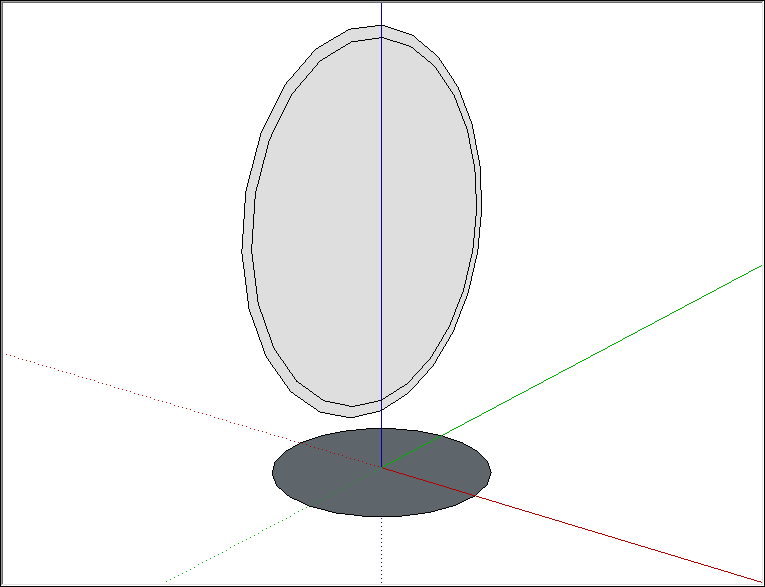
- With the Line tool (
 ), draw ii lines: one that divides the outer circumvolve in half and one that divides the inner circle that you created with the Offset tool.
 - With the Eraser tool (
 ), erase the top half of the second circle and the confront that represents the inside of the bowl. When you're done, you have a profile of the bowl.
 - With the Select tool (
 ), select the edge of the circumvolve on the ground aeroplane. This is the path the Follow Me tool will employ to complete the bowl.
 - With the Follow Me tool (
 ), click the contour of the basin. Your bowl is complete and yous tin can delete the circle on the ground plane. The following figure shows the bowl profile on the left and the bowl on the correct.
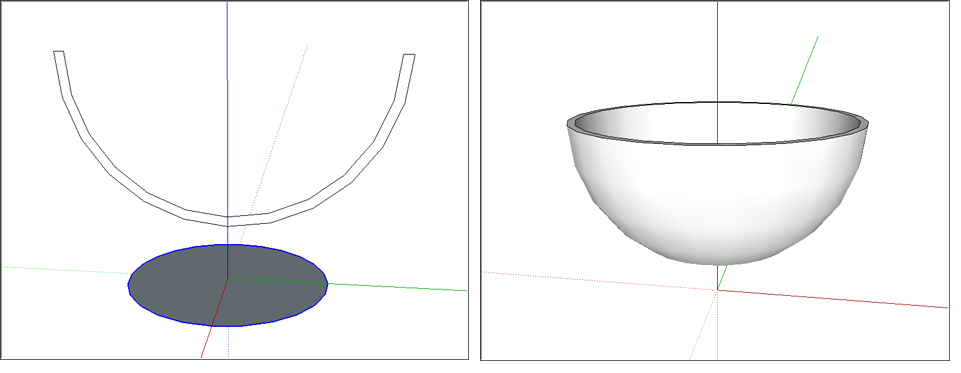
Note: Why exercise you have to draw two lines to separate the offset circles? When you depict a circumvolve using the Circle tool (or a curve using the Arc tool, or a curved line using the Freehand tool), y'all are actually drawing a circle (or arc or curve) entity, which is made of multiple-segments that deed like a single whole. To delete a portion of a circle, arc, or curve entity segment, y'all need to break the continuity. The beginning line y'all draw creates endpoints that break the segments in the outer circle, but not the inner circle. Cartoon the second line across the inner circle breaks the inner circumvolve into two continuous lines.
You lot can use these aforementioned steps to create a dome by simply drawing your profile upside down. To create a sphere, yous don't need to modify the second circumvolve to create a profile at all. Cheque out the post-obit video run into how to create a sphere.
Creating a cone
In SketchUp, you can create a cone by resizing a cylinder face or past extruding a triangle along a circular path with the Follow Me tool.
To create a cone from a cylinder, follow these steps:
- With the Circle tool, draw a circumvolve.
- Use the Push/Pull tool to extrude the circle into a cylinder.
- Select the Move tool (
 ).
). - Click a cardinal signal on the height edge of the cylinder, as shown on the left in the figure. A primal point is aligned with the red or light-green axis and acts equally a resize handle. To find a cardinal signal, hover the Move tool cursor around the edge of the top cylinder; when the circumvolve edge highlighting disappears, this indicates a primal signal.
- Move the edge to its centre until it shrinks into the point of a cone.
- Click at the center to complete the cone, equally shown on the left in the effigy.
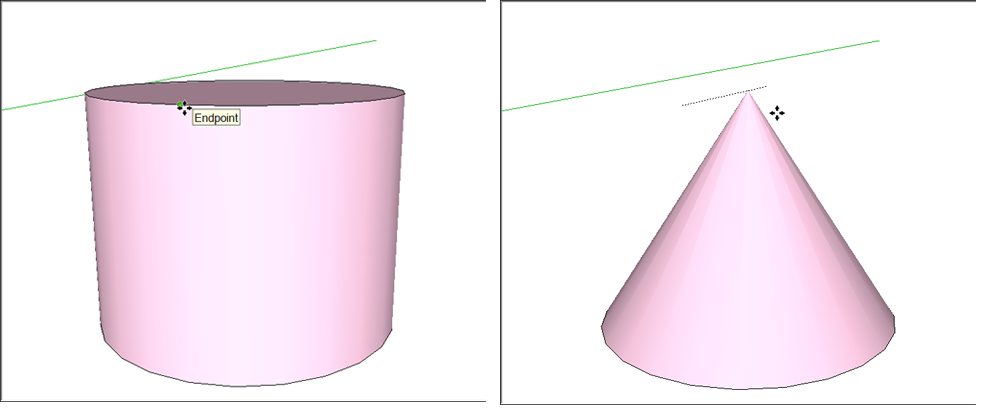
Here are the steps to model a cone by extruding a triangle along a circular path:
- Depict a circle on the ground aeroplane. You lot'll find it's easier to marshal your triangle with the circle's eye if you start drawing the circle from the axes origin.
- With the Line tool (), draw a triangle that's perpendicular to the circumvolve. (Encounter the left image in the following figure.
- With the Select tool (), select the face of the circle.
- Select the Follow Me tool () and click the triangle face, which creates a cone almost instantaneously (as long as your computer has the sufficient memory). You lot can run into the cone on the right in the post-obit effigy.
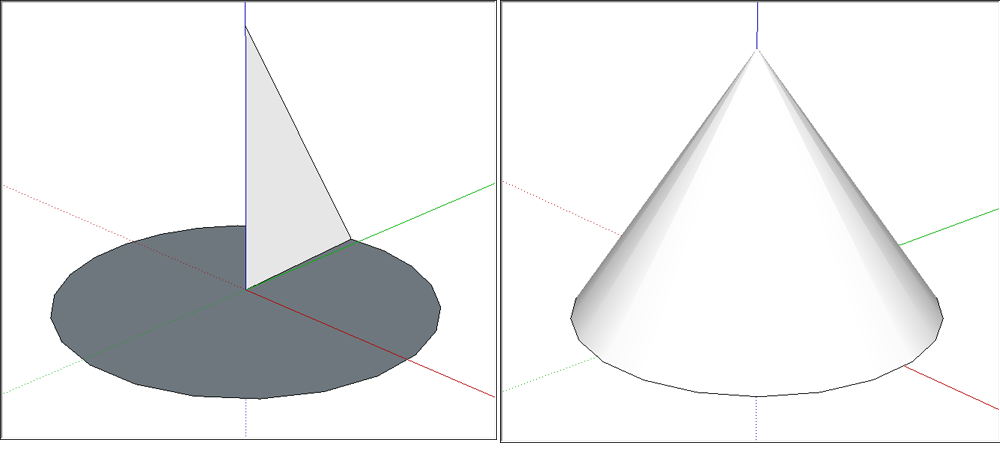
Creating a pyramidal hipped roof
In SketchUp, yous can easily draw a hipped roof, which is just a simple pyramid. For this example, you encounter how to add together the roof to a simple one-room house, too.
To describe a pyramid (pull up a pyramidal hipped roof):
- With the Rectangle tool (
 ), draw a rectangle large enough to encompass your edifice. To create a true pyramid, create a foursquare instead of a rectangle. The SketchUp inference engine tells you when you're rectangle is a square or a golden department.
 - With the Line tool (), draw a diagonal line from 1 corner to its opposite corner.
- Draw another diagonal line from one corner to another. In the figure, you run into how the lines create an Ten. The example shows the faces in X-Ray view then you can see how the rectangle covers the flooring plan.

- Select the Movement tool () and hover over the center point until a green inference point is displayed.
- Click the centre betoken.
- Move the cursor in the blueish direction (upward) to pull upwardly the roof or pyramid, as shown in the figure. If you need to lock the motility in the blue direction, press the Up Arrow key every bit you motility the cursor.
- When your roof or pyramid is at the desired acme, click to finish the move.
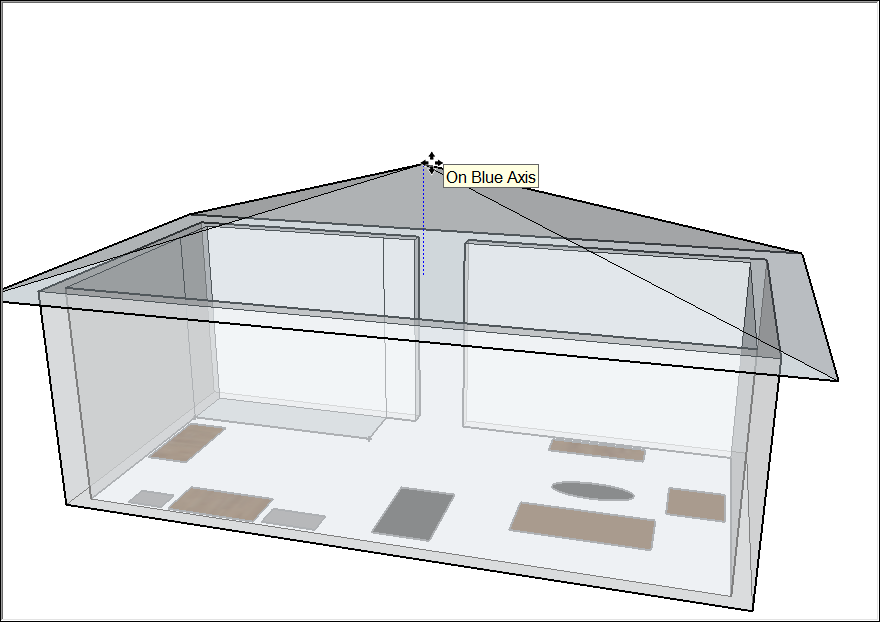
Tip: When y'all're creating a model of house or multistory building, organize the walls and roof or each floor of your edifice into separate groups. That manner, yous can edit them separately, or hide your roof in order to peer into the interior floor program. See Organizing a Model for details virtually groups.
In SketchUp, the easiest way to start a 3D building model is with its footprint. After you accept a footprint, you can subdivide the footprint and extrude each section to the correct tiptop.
Here are a few tips for finding a edifice's footprint:
- If you're modeling an existing building, trace the outline of the building with the drawing tools. Unless the building is obscured by copse, y'all can find an aerial photo on Google Maps and trace a snapshot. From within SketchUp, y'all can capture images from Google and load them directly into a model, every bit shown in the post-obit figure.
- If you lot don't have an aerial photograph of the existing edifice you want to model, you may demand to try the old fashioned route: measuring the outside to create the footprint and drawing the footprint from scratch. If literally taking measurements of an entire building is impractical, you can employ tricks such as using the measurement of a single brick to gauge overall dimensions or taking a photo with an object or person whose length you lot do know. See Measuring Angles and Distances to Model Precisely for more details.
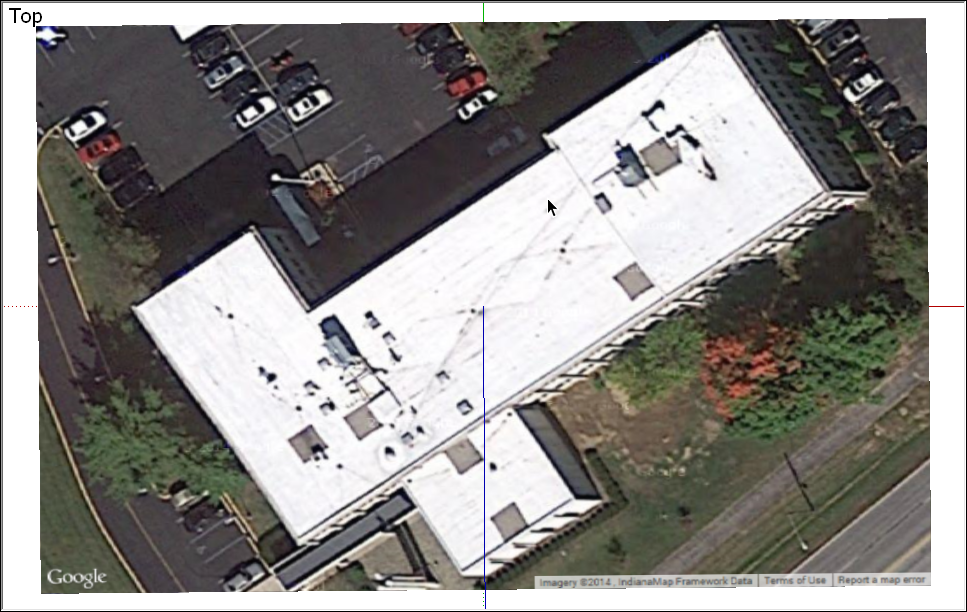
If y'all're able to start with a snapshot of your footprint, the following steps guide you through the procedure of tracing that footprint. Beginning, set up your view of the snapshot:
- Select Camera > Standard Views > Summit from the menu bar.
- Select Photographic camera > Zoom Extents to make sure you can run into everything in your file.
- Use the Pan and Zoom tools to frame a good view of top of the building that yous desire to model. You demand to be able to see the building clearly in club to trace its footprint. Meet Viewing a Model for details about using these tools.
- Cull View > Face Style > X-Ray from the menu bar. In X-Ray view, y'all can see the top view of the building through the faces that yous describe to create the footprint.
After you gear up your snapshot, effort the techniques in the post-obit steps to trace the edifice footprint:
- Set the drawing axes to a corner of your building. Come across Adjusting the Cartoon Axes for details.
- With the Rectangle tool (), depict a rectangle that defines part of your edifice. Click a corner so click an reverse corner to draw the rectangle. If your building outline includes non–xc-degree corners, curves or other shapes that you lot tin can't trace with the Rectangle tool, use whichever other cartoon tools you need to trace your edifice'south footprint.
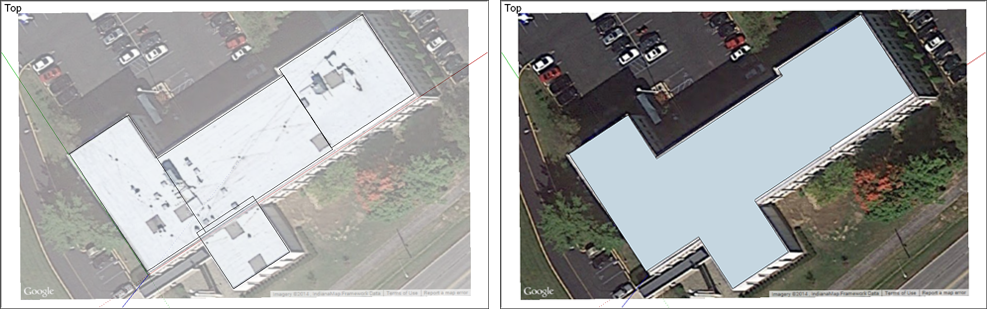
- Go along drawing rectangles (or lines and arcs) until the unabridged edifice footprint is divers by overlapping or side by side rectangles, as shown on the left in the following figure. Make sure at that place aren't any gaps or holes; if there are, fill them in with more rectangles.
- With the Eraser tool (), delete all the edges in the interior of the building footprint. When you lot're washed, you should have a single face defined by a perimeter of direct edges. You may want to plow off X-Ray view, as shown on the right in the following figure, in social club to see your faces and final footprint clearly.
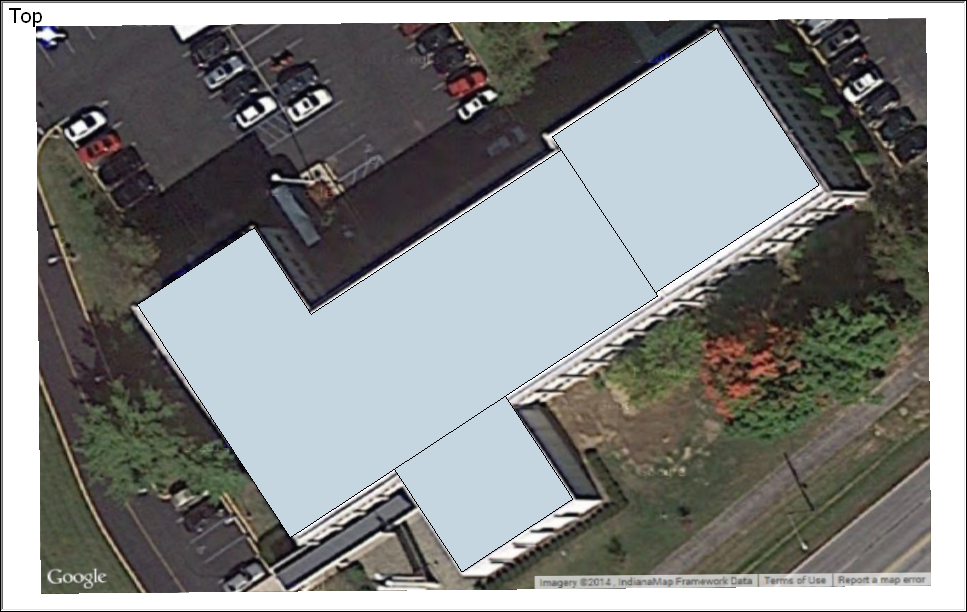
- Some simple buildings accept a single exterior wall height, but virtually have more than one. After y'all complete the footprint, employ the Line tool to subdivide your building footprint into multiple faces, each respective to a different exterior wall elevation, as shown in the post-obit figure. Then, you can use the Push/Pull tool () to extrude each area to the correct building height.
Creating a polyhedron
In this example, y'all meet how to create a polyhedron, which repeats faces aligned around an axis.
To illustrate how you can create a complex shape with basic repeating elements, this example shows you how to create a polyhedron called a rhombicosidodecahedron, which is made from pentagons, squares, and triangles, as shown in the figure.
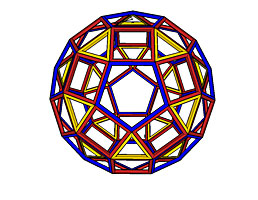
The post-obit steps explicate how to create this shape past repeating faces effectually an axis:
- Establish the correct angle between the first square and the pentagon, and between the first triangle and the square. See Measuring Angles and Distances to Model Precisely for details about measuring angles with the Protractor tool.
- Mark the exact middle point of the pentagon, which is shown here on a light-green surface that has been temporarily added to the pentagon component. This is the axis around which the copies will be aligned.
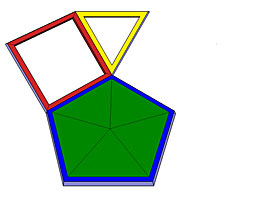
- Brand the foursquare and triangle components, and and so group the two components. For details about components, see Developing Components and Dynamic Components. To learn about groups, see Organizing a Model.
- Preselect the objects that you want to re-create and rotate (in this instance, the grouping you lot merely created).
- Select the Rotate tool (
 ).
). - Marshal the Rotate cursor with the pentagon face up and click the center point of the pentagon, as shown in the post-obit figure.
- Click the Rotate cursor at the indicate where the tips of the foursquare, triangle, and pentagon come together.
- Press the Ctrl fundamental to toggle on the Rotate tool'due south copy role. The Rotate cursor changes to include a plus sign (+).
- Movement the cursor to rotate the selection effectually the centrality. If y'all originally clicked the signal where the tips of the square, triangle, and pentagon came together, the new group snaps into its new position, as shown in the following figure.
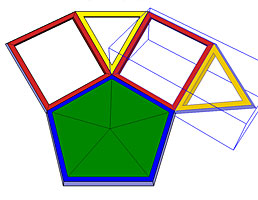
- Click to finish the rotate operation.
- Continue rotating copies effectually the axis until the shape is complete. As yous build the rhombicosidodecahedron, you demand to group different components together, and rotate copies of those groups around various component faces.
Tip: If the component you are rotating effectually is not on the red, green, or blue plane, make sure the Rotate tool'southward cursor is aligned with the confront of the component before you click the heart point. When the cursor is aligned, press and hold the Shift central to lock that alignment as you movement the cursor to the center betoken.
caldwellbastoofter.blogspot.com
Source: https://help.sketchup.com/en/sketchup/modeling-specific-shapes-objects-and-building-features-3d
0 Response to "how to draw a 3d half cylindrical prism"
Post a Comment